MBA Career News via E-mail

Enter your email address:

Subscribe the blog via your e-mail to get current news and reviews about MBA books, education and career.

Education Resources

Types of Communication and Impact of Communication

Friday, September 11, 2009

We already have discussed about communication process and communication barriers in our previous post. Here, I want to tell about types of communication and impact of communication on human behaviour.

Communication is possible with words. We talk to our friend to write a letter or E-mail. It means we are talking through words. We are establishing a communication with our friends. This is one type of communication but here we will discuss on many types of communication.

Communication through words:

When a baby cries, the mother turns to her. Communication through spoken words or written words is called verbal communication. Verbal communication is known as spoken communication also.

Non-verbal communication:

Non-verbal communication is known as communication without words. In this process we don’t use words to send or receive massages. We can categories non-verbal communication as:

Gestures

Body Language

Posture

Facial Expression

Eye Gazing

Impact of Communication on human behaviour or performance:

Effective communication is known as the well-defined strategy that enables any organization to achieve its set goals. A close tie between business, performance, technology and communication strategies provides a strong base for understanding and support within an organization.

The performance of an individual is either enhanced or hampered depending upon the effectiveness of communication in the work place. An organization is more than a set of by-laws, financial reports or organizational charts. It is a group of ‘people’. We cannot deny the social aspects of the workplace because it inhibits the transfer of information and knowledge and hinders the organization’s ability to outperform and innovate.

Just turn around- you may be in the cafeteria, front office, recreation area or the administrative block. Pay attention to different communication that I going on. Are they clear? Are they too harsh or too dry? How are they perceived? Is the receiver of the message accepting or rejecting the message? Do people care to what you say? Do you accomplish your goal? It is more than often that you are in a dilemma about issuing new instructions.

Effective communication enables you to hold a “relaxed” meeting and read to them what you wrote so that they could critique.

Communication Process and Communication Barriers in an Organization

Monday, August 17, 2009

Mostly, “Communication” term is used by behavioural theorists, management scholars and the general public. We will follow here some definition of communication which has been varyingly defined over the years.

I am going to share some definition of communication process from one of the MBA books - MB0023.

According to the Newman and Summer, communication is used as,
“an exchange of facts, ideas, opinions or emotions by two or more persons.”
Here Newman and Summer theorizes communication as an exchange of views.

Hoben defines it as,
“Communication is the verbal interchange of thought or idea.”
He is not dealing with written and visual communication.

We get a good definition about communication by Anderson who says,
“Communication is the process, by which we understand others and in turn endeavor to be understood by them. It is dynamic, constantly changing and shifting in response to the total situation.”
So, the definition is in the process and continuances.

Function and Purpose of Communication

In an organization communication helps to establish and disseminate the goals. It facilitates the development of plans for the achievement of goals. Communication helps to manage and utilizes manpower and other resources in the most effective and efficient manner. Communication helps manager lead, direct and motivate employees to contribute right things.

Process of Communication

Normally, communication is known as interpersonal, wherein the information or message is transferred from one person to the others. Transmitting person of the message is called the sender or transmitter. Receiver of message is called the receiver. The process of converting information that has to be sent, into a format which the receiver can understand is known as encoding.

Information can be encoded into various formats – oral, written or visual. To show each of the formats we had to go through a medium called channel. There are many channels of communication which may be a letter, memorandum, computer, telephone, fax, telegram or a television.

Information which is transferred to the receiver has to be interpreted. Interpretation is known as decoding. The process of replying is known as feedback. Here is a diagram of communication process:

Communication Process Diagram

So, to send any message a sender chooses a suitable channel and finally receiver sends a message back to the sender.

Barriers to Effective Communication

In each process of communication – encoding, transference and decoding, there may be possibility of interface. It may hamper the communication process. This is known as noise. It is just like carrying water in leaky bucket. Barriers are also major difficulties during message transferred. To ensure clarity in communication, barriers must be eliminated or minimized.

Barriers of communication can be defined as

Linguistic and cultural differences: It creates the problem for receiver to complete or understand the language used by the transmitter.

Environment: Noise is the basic barriers in the types of environment barriers of communication.

Channel: A faulty fax machine, a crackling phone or illegible hand-writing can be barriers of channel communication.

Receiver’s Attitude and Behaviour: The type comes basically in organization to satisfy clients. It can lead the inaccurate hearing of the information.

Transmission Journey: There can be some difficulties during transmission journey. So, it is necessary to repeat the massage and use more than one channel to communicate a message.

Lack of Planning: Purpose to communicate a person should be very clear. So, planning is the most effective thing to void lack of planning in communication.

Semantic Distortion: The distortion comes in the uses of words. It may be a serious barrier to effective communication.

At last, we can sum up communication definition, function, process and barriers. To handle a person or an organization it is the most necessary thing to understand communication, communication process and communication barriers. There should be a planned way of communication to understand or send a message.

Leader and Leadership in an Organization

Thursday, July 9, 2009

There are great debate on leader and leadership. Some of the people say that leaders are born not made but some are against it. It is said that Alexander/Julius Caesar were leader from born.

On the chapter we have to discuss about leader and leadership in an organization. A manager should be leader or not? A manager has better quality of leaders or leaders have better quality of managers?

Leadership objectives:

Meaning of leadership

Qualities of a good leader

Theories of leadership

Different types of leaders

Functions of a leader

Differences between ‘managers’ and ‘leaders’

According to the Haiman Leadership is, “the process by which an executive or a manager imaginatively directs, guides and influences the work of others in choosing and attaining specified goals by mediation between the individual and organization in such a manner that both will obtain the maximum satisfaction.” In other word we can say leadership is, “the relationship in which one person influences others to work together willingly on related tasks to attain that level which he desires.”

Some quality of a good leader:

Has foresight

Has influence

Has representative role playing

Communicates properly

Commands attention and respect

Helps to achieve task objectives

Commands trust and confidence

Is sensitive to the task, people and environment

Builds team and becomes a model

Has the ability and skill to manage the team

Has the ability to take decision and many more

In the leadership theories “Great Man” theories comes first and according to it great leaders are born, not made.

According to trait theories people inherit certain qualities and traits that make them better suited to leadership.

According to Contingency theories leadership focus on particular variables related to the environment that might determine which particular style of leadership is best suited for the situation.

According to situational theories leaders choose the best course of action based upon situational variable.

According to the behavioural theories leaders are based upon the belief that great leaders are made, not born.

According to the participative theories ideal leadership style is one that takes the input of others into account.

Management theories focus on the role of supervision, organization, and group performance.

Relationship theories focus upon the connections formed between leaders and followers.

About the classification of leadership we know these types:

Bureaucrat Leaders

Autocrat Leaders

Diplomat Leaders

Expert Leaders

Quarter Back Leaders

But according to the Chris Argyris leadership classification leaders types are:

Directive type

Permissive type

Participative type

Abraham Zaleznik (1977), delineated differences between leadership and management. He saw leaders as inspiring visionaries, concerned about substance; while managers are viewed as planners who have concerns with process. Warren Bennis (1989) further explained a dichotomy between managers and leaders. He drew twelve distinctions between the two groups:

Managers administer, leaders innovate.

Managers ask how and when, leaders as what and why.

Mangers focus on systems, leaders focus on people.

Managers do things right, leaders do the right things.

Managers maintain, leaders develop.

Mangers rely on control, leaders inspire trust.

Managers have a short-term perspective, leaders have a long-term perspective.

Managers accept the status-quo; leaders challenge the status-quo.

Managers have an eye on the bottom line, leader have an eye on the horizon.

Managers imitate, leaders originate.

Managers emulate the classic good soldier, leaders are their own person.

Managers copy, leaders show originality.

In the end of the chapter we can say leaders are far ahead from a manager. Manager vision should be like a leader. Above mentioned all the resources will clear you about the function of a manager and leaders. In this term we can say leaders purpose are for high term however manager purposes are for short-term.

Groups and Group Dynamics

Monday, June 8, 2009

The group concept is as old as civilization. In the primitive age group was a basic unit of survival. On this group chapter we have to focuses on group dynamics and principles of group dynamics.

Groups and Group Dynamics Objectives:

Meaning of group

Characteristics and functions of groups

Different types of groups

Group characteristics

Group dynamics and principles of group dynamics

About group Kimball Young defines, “two or more persons in a state of social interaction.” Sherif and Sherif define about group as, “a social unit which consists of a number of individuals who stand in definite status and role relationships to one another and which possesses a set of values or norms of its own regulating the behaviour of individual members, at least in matters of consequence to the group.”

Normally group characters define in four parts 1) two or more people, 2) who interact with one another, 3) share some common ideology, and 4) see themselves as a group.

On the formal group MBA book MB 0027 writes, “The formal work group has a designated leader who supervises group members, mediates rewards and punishments, and is responsible for group performance to a higher authority in the organization.”

On the informal work groups, “Informal groups are loosely organized groups such as bowling teams and social clubs that arise apart from the formal organization to which members of the informal group may belong.”

Thomas Harrll has defined group dynamics as, “an expression that describes the situation in which people acting together in a group accomplish certain thing, either positively or negatively in a way that cannot be explained adequately in terms of the individual acting separately.”

Cartwright has termed principles of group dynamics which are:

If a group is to be used effectively as a medium of change, those who are to be changed and those who are to wield an influence for change must have a strong sense of belonging to the same group, i.e., the barriers between the leaders and the led should be broken down.

The more attractive a group is to its members, the greater the influence it would exercise on its members.

The higher the prestige of a group member in the eyes of the members, the greater the influence he will exercise on them.

Information relating to the need for change, plans for change, and the consequence of change must be shared by all the members of a group.

In the end of the chapter we can say that group dynamics is concerned with the interactions and forces between group members in a social situation.

Grievance and Grievance Procedure

Friday, May 1, 2009

Grievances always vary from company to company and it has many definitions also by many authors. Grievance is used company to indicate various forms and stages of an employee’s dissatisfaction.

According to the Dale Yoder, “a written complaint filled by an employee and claiming unfair treatment.” Another definition comes with Prof. Jucious who defines as, “any discontent or dissatisfaction, whether expressed or not and whether valid or not, arising out of anything connected with the company that an employee thinks, believes or even feels unfair, unjust or inequitable.”

There are various factors which arise Grievances. A grievance is always a symbol of some malfunctioning or maladjustment and an able and skillful manager can always find out the real or submerged reasons for a grievance.

The dispute or grievance constitutes a managerial problem and the scientific method is usually most productive in arriving at a satisfactory solution.

On the Grievance handling procedure from MBA books, MB 0027 writes:

A grievance should be dealt within the limits of the first line supervisor.

The appellate authority should be made clear to the employee so that is he cannot get satisfaction from his immediate supervisor, he should know the next step.

The grievance should be dealt with speedily.

In establishing a grievance procedure, if the grievance is against an instruction given by a superior in the interest or order and discipline, the instructions must be carried out first and then only employee can register his protest.

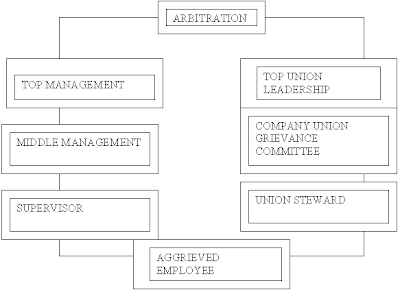
Grievance Handling Procedure
Grievance Handling Procedure Image

In the grievance handling the some factors include:

Receive and define the nature of the dissatisfaction.

Get the facts.

Analyze and divide.

Apply the answer.

Follow up.

In establishing a grievance procedure, if the grievance is against an instruction given by a superior in the interest of order and discipline, the instructions must be carried out first and then only employee can register the protest.

In the language of the labour management relations, a grievance is a complaint formally presented by the employee or employees to the management.

In case, the grievance has not been settled by top management and top union leadership, the same may be submitted to an impartial arbitrator.

Join MBA Blog